Most water cart breakdowns are not dramatic. A water filter that was never cleaned, an engine that missed an oil change, a hose that was taped instead of replaced, a pump left full of water on a frosty night. Each one is cheap to prevent and expensive to fix on a dusty morning with a consent condition to meet.
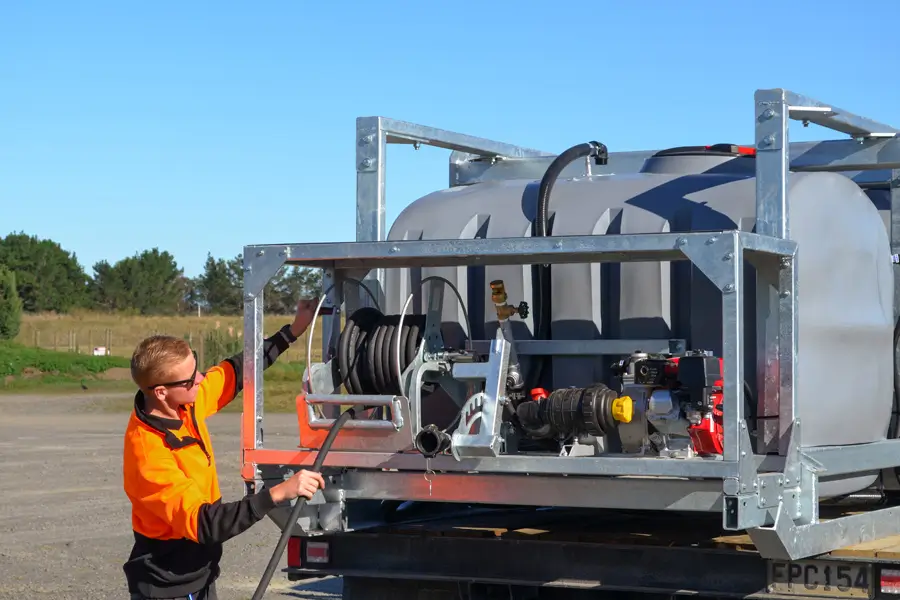
The AquaMaster 2000 providing reliable water delivery for plant watering, supporting
healthy growth and garden maintenance.
Log Hours, Not Just Months
Honda advises commercial users to log operating hours to set service intervals. A water cart on dust suppression can run 100 hours in a few busy summer weeks, then sit idle all winter. Service at whichever comes first, hours or months, and write it down. A logbook in the cab is enough, and it is the first thing a buyer asks for if you ever sell the unit.
Every Day: the Five Minute Check
Oil and fuel on every engine. The current standard specification AquaMaster 2000 has two, a Honda GX690 on the water blaster and a Honda GX200 on the high flow pump.
Leaks at camlock fittings, hose joints and pump housings.
Hoses and nozzles for cuts, bulges and worn fittings. Replace a damaged high pressure hose rather than taping it. At up to 3500 psi, a pinhole leak can inject water through skin.
Water in the tank before starting either pump. Never run a pump dry, or the water blaster with the supply closed.
End of day: bleed off pressure, drain hoses if frost is likely and refuel, as set out in the setup guide.
Engine Servicing: the Honda Intervals
The current standard specification AquaMaster pump engine is a Honda GX series engine, chosen because parts and service agents are easy to find across New Zealand. Honda publishes these core intervals:
Task
Interval
First oil change
First month or 20 hours
Engine oil change
Every 6 months or 100 hours
Clean air filter
Every 3 months or 50 hours, more often in dust
Check and clean spark plug
Every 6 months or 100 hours
Replace spark plug
Every year or 300 hours
The air filter needs extra attention. A water cart on dust suppression works in exactly the conditions that choke a filter, and a blocked filter means hard starting, lost power and faster engine wear. On dusty sites, check it weekly.
Use SAE 10W-30 four stroke engine oil meeting API SJ or later specifications, as Honda recommends. The Honda GX690 fitted to the water blaster includes a replaceable oil filter. Honda recommends replacing the oil filter every 200 operating hours as part of scheduled servicing. All current AquaMaster engines are electric start, so keep battery terminals clean and charge the battery if the unit is parked for a while.
High Pressure Pump Care (AquaMaster 2000)
The water blaster pump has its own oil, separate from the engine. Comet, who make the high pressure pump, recommends changing the pump oil after the first 50 hours and then every 500 hours. Check the pump oil level regularly and inspect for signs of contamination or water ingress. Milky or creamy oil means water has got past the seals, so get it looked at before the damage spreads.
Three habits protect the pump:
Never run it with the water supply closed or the tank empty.
Watch for pressure loss or pulsing. A worn nozzle is the usual cause and the cheapest fix.
Bleed pressure after shutdown so the seals are not holding pressure overnight.
Gearbox Oil Maintenance
The high flow pump gearbox has its own oil supply, so include it in routine servicing. Check the oil level regularly using the sight glass and keep it at the level specified in the operator handbook. The gearbox uses SAE 90 gear oil. Change the oil and inspect the gearbox at the intervals set out in the operator handbook.
Tank and Water Quality
Grit is the enemy of pumps, seals and nozzles. An inline water filter sits between the tank and the pump, so solids, dirt and mud are caught before they reach it. Check and clean the filter regularly. A clogged filter restricts flow to the pump, which can also cause problems.
Fill from clean sources where you can. If you fill from a stream or dam, where consent allows, use a strainer on the fill line and clean it often.
Flush the tank every few months, or whenever sediment builds up.
Do not leave water standing for weeks in warm weather. Algae grows in stale water and blocks fine nozzles.
Keep the lid closed. On the AquaMaster 2000, keep the overhead refill and its air gap clear and undamaged, as it keeps your filling compliant with council backflow rules.
Clean water matters even more when the water cart supplies other machines, for example refilling a hydrovac on a potholing job.
Trailer Checks: AquaMaster 2000
The AquaMaster 2000 is a light trailer, so it needs a current warrant of fitness. A new trailer’s first WoF is issued for three years, then it needs one every 12 months. It must stay at WoF standard between inspections, so check regularly:
Tyres: tread depth, pressures and sidewall damage.
Wheel nuts and bearings. A hub that is hot to touch after a tow is a warning sign.
Brakes: the mechanical brakes should apply and release cleanly.
Lights, wiring and the plug.
Coupling and safety chain, on whichever tow ball you use (1-7/8 inch or 50 mm).
Hose mud and concrete slurry off the galvanised chassis, especially after coastal or roading work. Galvanising is tough, but caked mud holds moisture against the steel.
Skid Tank Checks: AquaMaster 4000 and 6000
The AquaMaster 4000 skid tank securely tied down on a flat deck truck.
Skid tanks have no running gear, but they take a beating being lifted, tied down and moved between trucks.
Check the skid frame for cracks or distortion, especially around lifting points and the forklift slots on the 6000.
Inspect tie down points and straps every time the unit goes on a truck.
Make sure the hose reel turns freely and the 25 m hose rewinds without kinking.
Test the integrated dust suppression nozzles and, if fitted, the optional remote switch that turns the water on and off from the cab.
Confirm the truck’s payload suits a full tank: 5000 kg or more for the 4000, 7000 kg or more for the 6000.
Winter and Storage
Frost is the fastest way to crack a pump housing or split a fitting, and it does not take a Central Otago winter to do it. When frost is forecast, drain the pumps and hoses, or park the unit somewhere frost free. The tank has room for water to expand as it freezes. The pumps and hoses do not. Follow the pump maker’s frost protection advice for the high pressure pump.
If the water cart will be parked for more than a month:
Drain or stabilise the fuel. Old petrol is a common cause of hard starting.
Change the engine oil before storage, not after.
Charge the batteries, or connect a maintainer.
Store it under cover and out of direct sun to protect hoses and seals.
Grease Points
The AquaMaster 2000 trailer has a few grease points: the hose reel swivel, tow coupling, jack stand pivot and suspension rocker points. Some, like the hose reel swivel, also apply to other AquaMaster models. Grease them as part of routine servicing.
Quick Reference Schedule
When
AquaMaster 2000
AquaMaster 4000 and 6000
Daily
Oil and fuel on both engines, leaks, hoses, nozzles, bleed pressure
Oil and fuel, leaks, hose, nozzles, tie downs
Weekly
Air filters on dusty work, inline water filter, tyres, lights, gearbox oil level
Air filter on dusty work, inline water filter, frame and straps
50 hours or 3 months
Clean air filters
Clean air filter
100 hours or 6 months
Engine oil, spark plugs
Engine oil, spark plug
300 hours or yearly
Replace spark plugs. Pump oil every 300 hours (first change at 50 hours)
Replace spark plug
Yearly
Trailer WoF (after the first three years)
Frame and hose reel inspection
Signs Your Water Cart Needs Attention
Pressure drops or pulses on the water blaster.
Milky oil in the high pressure pump.
An engine that is hard to start or loses power under load.
Water weeping from camlocks or pump seals.
A hub that is hot to touch after towing.
Any one of these is a small job today and a bigger one next week.
Maintenance Is Part of the Cost of Ownership
A well maintained water cart works harder, breaks down less and holds its resale value. That is part of why ownership beats ongoing hire for regular users, as covered in Hire or Buy a Water Cart in NZ, and why build quality and parts access matter when you compare prices in our water trailer cost guide. The same applies across your fleet. When we break down hydroseeding cost in NZ, servicing sits alongside fuel and labour as a real running cost.
All current AquaMaster models use Honda engines and off the shelf components from NZ suppliers, so most wear parts can be sourced locally. Our guide on what to know before buying a water cart explains why that matters. Talk to our team about parts, servicing or the right AquaMaster for your work.