If you have spent any time on NZ civil or infrastructure projects in recent years, you have probably heard hydro excavation coming up more often. Councils are recommending it. Utility companies are specifying it, and contractors who have used it once tend not to go back to mechanical digging for sensitive work.
So what is hydro excavation, exactly? And why are so many NZ contractors switching from traditional methods? This article covers both questions clearly.
What Is Hydro Excavation?
Hydro excavation, also called vacuum excavation or non-destructive digging, is a method of removing soil using a combination of pressurised water and a powerful vacuum system. High-pressure water breaks up the soil, and the vacuum simultaneously extracts the slurry into a holding tank (also known as a spoils tank) on the machine. The result is a precise, controlled excavation with very low risk of damaging whatever is underneath.
Unlike mechanical digging, which uses a bucket or auger to physically cut and displace soil, hydro excavation is non-destructive. The water loosens the ground, and the vacuum removes the material cleanly, leaving the area around underground assets untouched.
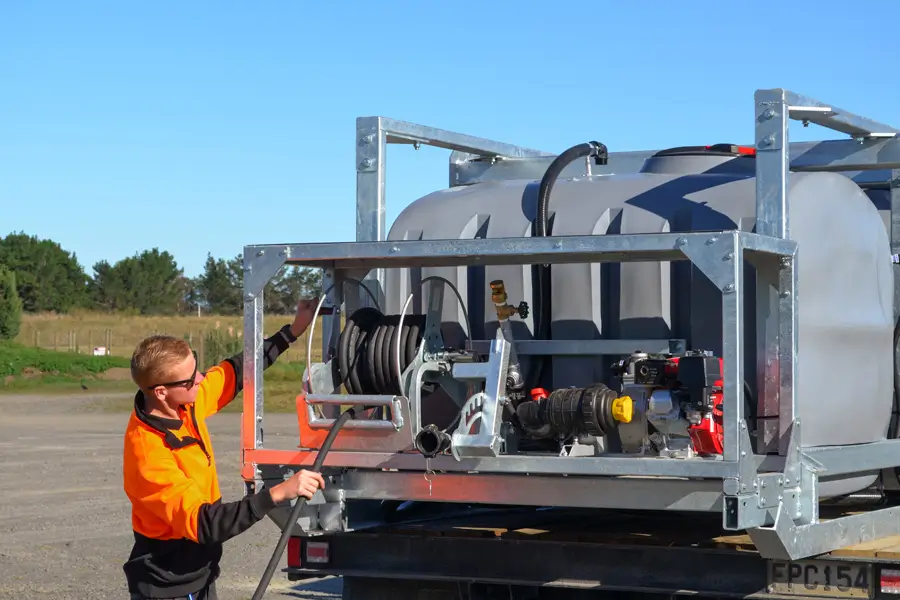
The HydroMaster 2000 is Master Machinery’s truck-based (not trailer-based) hydro excavation unit, built for NZ civil and utility work. It is mounted on a skid frame that gets tied down to a flat deck truck and designed for sites where access is tight and precision is essential.
How Does Hydro Excavation Work?
The process follows a straightforward sequence:
A high-pressure water jet is directed at the ground surface, breaking up soil, clay, or compacted material.
The loosened soil and water form a slurry, which is immediately drawn up by a powerful vacuum into the machine’s spoil tank.
The operator controls the depth and direction of excavation, working carefully around the known or suspected location of underground services.
Once the excavation is complete, the spoil is collected in the spoils tank and transported off-site for disposal at an approved location. Because the excavated material is a wet slurry, it cannot be used as structural backfill and must be disposed of at an approved site.
The combination of water pressure and vacuum means the excavation is precise enough to expose a single pipe, cable, or conduit without disturbing the surrounding material.
Why NZ Contractors Are Making the Switch
1. Safety Around Underground Services
New Zealand has an extensive network of underground infrastructure: fibre optic cables, power lines, gas mains, water pipes, and stormwater systems. On urban sites, particularly, the density of buried services creates real risk when mechanical excavation is used without exact knowledge of what is below.
Hitting a live power cable or gas main with a mechanical digger is not just a project delay. It is a serious safety event that puts workers and the public at risk and creates significant liability. Hydro excavation dramatically reduces this risk because the water jet and vacuum cannot sever or crush a buried asset the way a steel bucket can.
This is the primary reason utility companies and councils across NZ are increasingly specifying hydro excavation for works near existing underground services.
2. Precision and Reduced Reinstatement Costs
Mechanical excavation creates a wider dig than necessary, which means more soil removal, more disruption to the surrounding area, and more material to reinstate after the job. Hydro excavation allows the operator to expose exactly what is needed, nothing more.
A smaller, more precise excavation means less reinstatement work, less disruption to traffic or public spaces, and lower overall project cost. On urban sites where reinstatement of road surfaces, footpaths, or landscaping is expensive, this saving is significant.
3. Performance in Difficult Ground Conditions
NZ ground conditions vary considerably, from the soft volcanic soils of Auckland to the heavy clay common in Canterbury and the rocky terrain of the South Island. Mechanical digging can struggle in wet, unstable, or heavily compacted ground or require specialised attachments that add cost and complexity.
Hydro excavation is highly effective across a wide range of ground types. High-pressure water cuts through compacted clay, loosens rocky material, and works efficiently in wet conditions where mechanical equipment can become a liability.
4. Access in Tight or Confined Locations
Not every dig is in an open field. Urban utility work, confined spaces, work between existing structures, and sites with overhead or ground-level obstructions all create access challenges for mechanical equipment.
A skid-frame unit like theHydroMaster 2000 can be positioned at the edge of a confined area on its flat-deck truck, with the operator working the lance from a distance. This allows precise excavation in locations where a digger simply cannot fit or cannot operate safely.
5. Growing Regulatory and Specification Requirements
WorkSafe New Zealand guidance on working near underground services strongly favours non-destructive methods for initial exposure and service location. Several utility companies and local authorities now include hydro excavation as a preferred or required method in their work specifications.
For contractors working on council contracts, utility maintenance, or infrastructure upgrade projects, the ability to specify hydro excavation capability is increasingly a commercial advantage and in some cases a compliance requirement.
Common NZ Applications for Hydro Excavation
Hydro excavation is used across a wide range of civil and infrastructure projects in New Zealand:
Potholing and service location: exposing buried cables, pipes, and conduits for safe identification before main works begin.
Pole hole excavation: creating clean, precise holes for power poles, light poles, and signage foundations.
Drainage work: exposing existing drainage infrastructure for inspection, repair, or connection.
Subdivision and residential construction: safe excavation around existing services during new connections or upgrades.
Road and footpath repair: precise excavation for utility access without unnecessary surface damage.
Industrial and confined space excavation: where access limitations make mechanical equipment impractical.
The HydroMaster 2000: Built for NZ Civil and Utility Work
The HydroMaster 2000 is Master Machinery’s truck-based hydro excavation unit, designed specifically for the demands of NZ construction, civil, and utility work.
Key specifications:
Vacuum tank spoils capacity: 2 cubic metres
Compact skid frame dimensions: 4.6 x 2.2 x 2.15 m
Tare weight: 3000 kg, transportable on a minimum of a class 2 truck
Designed for tight-access sites and urban environments
Being truck-based, the HydroMaster 2000 can be loaded onto any suitable flat deck truck and moved quickly between sites. It can be operated by a single person using a remote control that manages the movement of the boom and machine functions, and is purpose-designed for the precision demands of utility and civil work.
If your next project involves any of the following, hydro excavation is worth considering seriously:
Work near existing underground services (power, gas, water, telecoms)
Urban or confined access sites where a digger cannot operate safely
Projects where the reinstatement cost is a significant factor
Council or utility contracts specifying non-destructive digging methods
Tight timelines where unexpected service strikes would cause costly delays
The HydroMaster 2000 is available to view at Master Machinery. Contact the team to discuss your project requirements and find out whether hydro excavation is the right solution for your next dig.