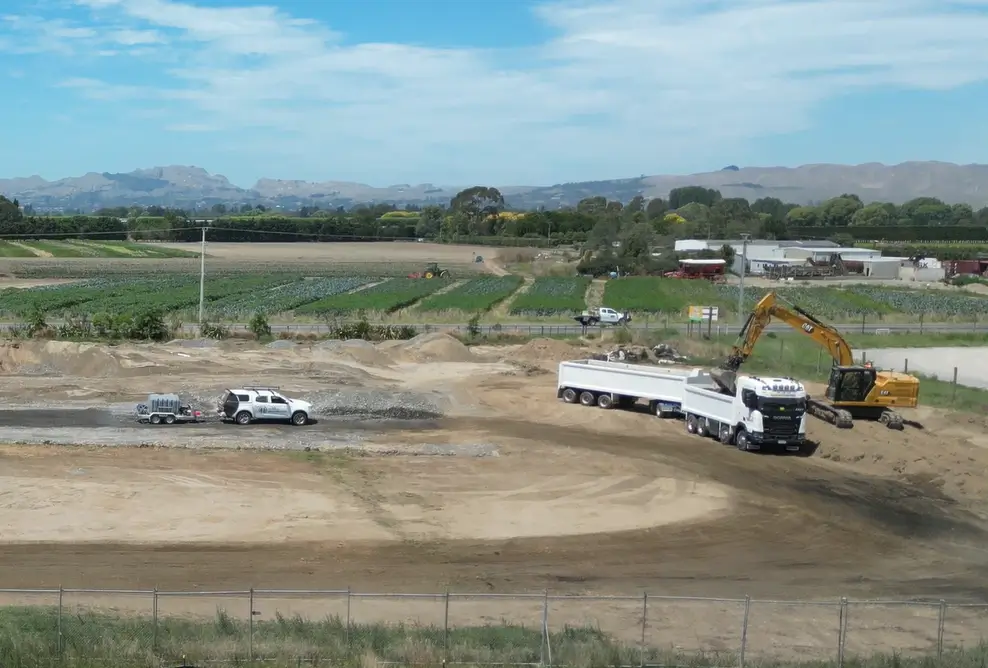
The moment earthworks finish on a batter, the clock starts. Exposed soil on a slope is the least stable it will ever be, and the first serious rain will take a portion of it downhill, into a drain, and eventually into a watercourse where a council officer will have an opinion about it.
Hydroseeding is the method most NZ civil contractors use to close that window quickly. This article covers why it works better than dry seeding on slopes, what actually goes into the slurry, what a realistic establishment timeline looks like, and how to get a good result on a steep face.
Why Exposed Slopes Are a Compliance Problem, Not Just an Untidy Finish
Erosion and sediment control is written into resource consent conditions and regional council erosion and sediment control plans on most earthworks projects in New Zealand. Many consents require vegetation to be established within a defined timeframe after ground disturbance, and stabilisation of exposed areas is a standard condition rather than an optional extra.
The practical consequence is that leaving a batter bare over winter because the landscaping contractor is booked out three weeks ahead is not a scheduling problem. It is a compliance exposure, and on a site where an inspector is already paying attention, it is the sort of thing that leads to abatement notices and stop-work conversations.
There is a commercial argument too. Sediment lost from a slope is material you paid to place, and reinstating a scoured batter after a rain event costs considerably more than seeding it did in the first place.
Why Dry Seeding Struggles on a Batter
Broadcasting seed by hand or with a spreader works well on flat, prepared ground. On a slope it runs into three problems at once.
Seed does not stay put. On anything steeper than a gentle grade, dry seed rolls, blows and washes to the bottom of the face. What germinates ends up concentrated in a strip along the toe of the batter, with the upper two thirds still bare.
There is nothing holding moisture at the surface. Slopes shed water rather than absorb it, and freshly placed topsoil on a face dries out fast in wind and sun. Germination needs consistent moisture at the seed, which is the exact thing a bare slope cannot provide.
Coverage is uneven and hard to verify. On a steep or uneven face, walking the area to spread seed is slow, sometimes unsafe, and almost never uniform.
Hydroseeding solves all three at once by applying seed suspended in a slurry that sticks where it lands, holds moisture around the seed, and can be applied accurately from a distance without anyone climbing the face.
What Is Actually in a Hydroseed Slurry
The mix is straightforward, and understanding it helps when you are specifying a job or reviewing what a subcontractor has quoted.
Seed. Selected for the site, the season and what the finished area needs to do. An erosion control mix on a road batter is a different specification from a subdivision lawn.
Mulch. Usually paper-based cellulose in the NZ market. It carries the seed, holds moisture at the soil surface and forms a protective layer over the face while germination happens. It is normally dyed green, which has the useful side effect of showing you exactly where you have already sprayed.
Tackifier or binder. Many modern premium cellulose mulches already include a tackifier as part of the product, which is sufficient for most standard hydroseeding applications. For steeper batters, high-risk erosion areas or sites where additional adhesion is required, a standalone tackifier can be added to improve the slurry’s ability to stay in place through heavy rain.
Fertiliser. Commonly a slow release starter to support establishment, particularly on subsoil and compacted fill where fertility is low.
The whole point is seed-to-soil contact plus retained moisture. On a bare slope, neither of those happens on their own.
Cellulose Mulch or Wood Fibre?
This comes up constantly, and the honest answer is that it depends on the machine as much as the job.
Paper-based cellulose mulch mixes readily, sprays smoothly, and suits the large majority of NZ erosion control and lawn establishment work. Wood fibre mulch is heavier and holds together longer on very steep or high-risk faces, but it needs a machine capable of mixing a thicker slurry, which usually means mechanical paddle agitation rather than jet agitation.
Jet agitation recirculates slurry through nozzles to mix the tank, with no moving parts inside the tank at all. Fewer wear parts, faster clean down, lower running costs. Paddle agitation handles heavier slurries but costs more to own and to service.
If your work is predominantly batters, banks, subdivisions and reserve seeding using cellulose mulch, a jet agitation machine is the more sensible ownership proposition. The SeedMaster 2000 is built specifically around that combination.
What the Establishment Timeline Looks Like
Timelines vary with season, aspect, soil and species, so treat these as planning ranges rather than promises.
In good spring or autumn conditions with adequate moisture, germination on a hydroseeded slope typically begins within one to two weeks, with visible cover developing over the following month. Through a NZ winter, soil temperatures slow everything down and establishment takes noticeably longer. Mid-summer applications carry the opposite risk, where the surface dries faster than the seedlings can cope with unless there is follow-up watering.
The important point for erosion control is that the mulch and binder layer starts protecting the surface from the day it is applied, well before anything has germinated. That immediate protection is a large part of why hydroseeding is treated as a stabilisation method rather than just a planting method.
Plan the application around the weather rather than the programme where you can. Spraying immediately ahead of light steady rain is close to ideal. Spraying two hours ahead of a downpour, before the binder has set, is money down the drain.
Where Hydroseeding Fits on NZ Projects
Cut and Fill Batters on Roading Projects
The most common application. Road formation leaves long runs of exposed cut and fill faces that need stabilising quickly and are awkward to access on foot. Spraying from the formation using a long hose covers the face without anyone working on the slope.
Subdivision Slopes and Reserve Banks
Subdivision development produces banks between terraced sections, reserve edges and stormwater basin batters, all of which need stabilising before handover and all of which are usually needed in a hurry.
Stockpiles and Long Term Exposed Areas
Where a stockpile or an exposed area will sit through a season, treating it early is one of the recognised ways of demonstrating active management of erosion and sediment to council inspectors rather than waiting until the project finishes.
Slip Repair and Post Storm Reinstatement
After a slip is repaired and the face is regraded, that surface is bare and unstable. Getting cover established quickly reduces the chance of the same face failing again in the next event.
Farm Tracks, Drains and Stream Banks
Rural earthworks leave exposed banks along new tracks, drain edges and stream margins. These are prime candidates because they are remote, they are steep, and nobody wants to hand seed them.
Getting the Application Right on a Slope
A few things separate a good result from an expensive redo.
Work top down. Start at the crest and work down the face so anything that runs lands on ground you are about to spray anyway.
Keep the rate consistent. The temptation on a big face is to stretch the tank. Under-applied slurry gives thin mulch cover and patchy strike, and you end up back on site.
Spray from a vantage point where you can see the whole face. This is where an elevated working platform makes a practical difference. Standing higher gives you a better line onto the upper part of a batter and better control of where the material is landing.
Check the surface before you start. Slurry sticks to soil. It does not stick well to a smooth, sealed, machine-tracked surface. A light scarification on compacted faces makes a substantial difference to the result.
Mind your water. Slurry is mostly water, so refill logistics set your productivity on a large job. Know where the fill point is and how long a round trip takes before the crew arrives.
The SeedMaster 2000
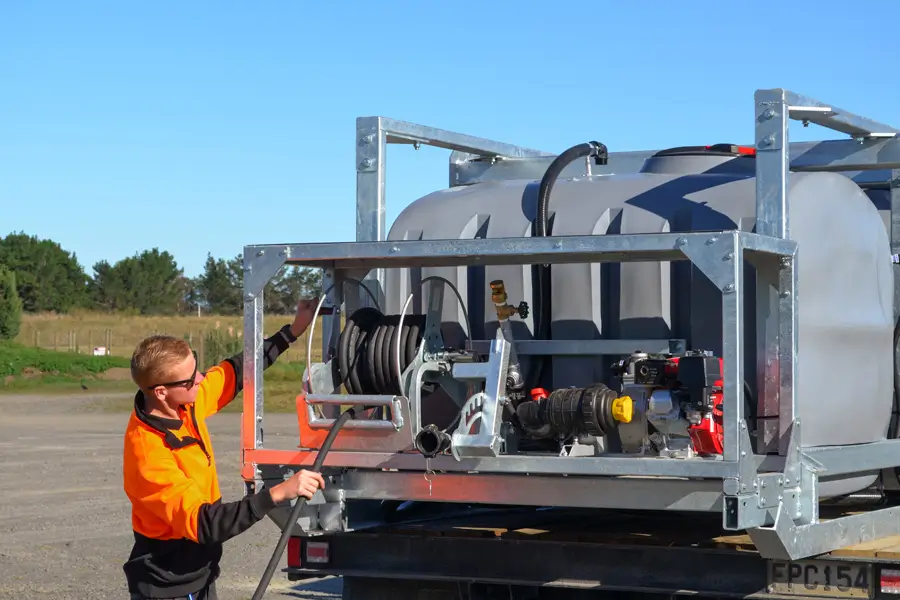
The SeedMaster 2000 is a 2000L trailer hydroseeder built for NZ contractors and landscapers working with cellulose mulch.
Key specifications:
Tank capacity: 2000L, covering 400 to 500 sqm per tank depending on mix and application rate
Jet agitation, with no moving parts inside the tank
Pump flow: 1400 L/min, which maintains spray throw to reach the full height of a batter from ground level
Hydroseed hose: 40m
Washdown hose: 25m, included as standard
Built-in dust suppression system with adjustable spray angle
Dimensions: 4.5 x 2.0 x 2.3 m, tare weight 1180 kg, trailer rated to 3500 kg
Two things about it are relevant specifically to slope work. The elevated walkway and integrated mulch mixing platform make loading faster and give the operator a higher vantage point for directing spray across a face. And the machine is laid out so every potential blockage point is accessible without specialist tools, which on a remote batter job is the difference between a five minute pause and an afternoon lost.
Because it tows behind any 3500 kg capable work ute, it also gets to places a truck-mounted unit will not, including farm tracks, partially formed subdivision roads and residential sites.
The washdown hose and the built-in dust suppression system mean the same trailer is useful between seeding jobs. For higher volume dust suppression across an active earthworks site you still want a dedicated water cart such as the AquaMaster 4000, and our article on dust suppression versus dust control explains where the line sits.
Subcontracting or Bringing It In House
Most civil contractors start by subcontracting hydroseeding, and for occasional work that is the right call.
The case for owning a machine builds when three things are true: you have erosion control obligations on most of your sites, you need to treat areas as they become exposed rather than waiting for the end of the job, and you are losing time waiting for a subcontractor to fit you into their programme. At that point the ability to spray a newly exposed face on the same day it is formed becomes a compliance tool as much as a cost saving.
For landscapers, the maths is different again. Hydroseeding is a billable line item, and lawn establishment on subdivisions is repeat work, so utilisation tends to be high enough to justify the machine on its own.
The Bottom Line
On a flat, prepared lawn area, dry seeding done well will get you there. On a slope, a batter or a road cutting, it will not, and the difference shows up the first time it rains hard.
Hydroseeding puts seed, mulch, binder and fertiliser onto the face in one pass, protects the surface immediately, and holds moisture where germination actually happens. On NZ projects where erosion and sediment control conditions are part of the consent, that combination is the difference between a stabilised slope and a conversation with the council.