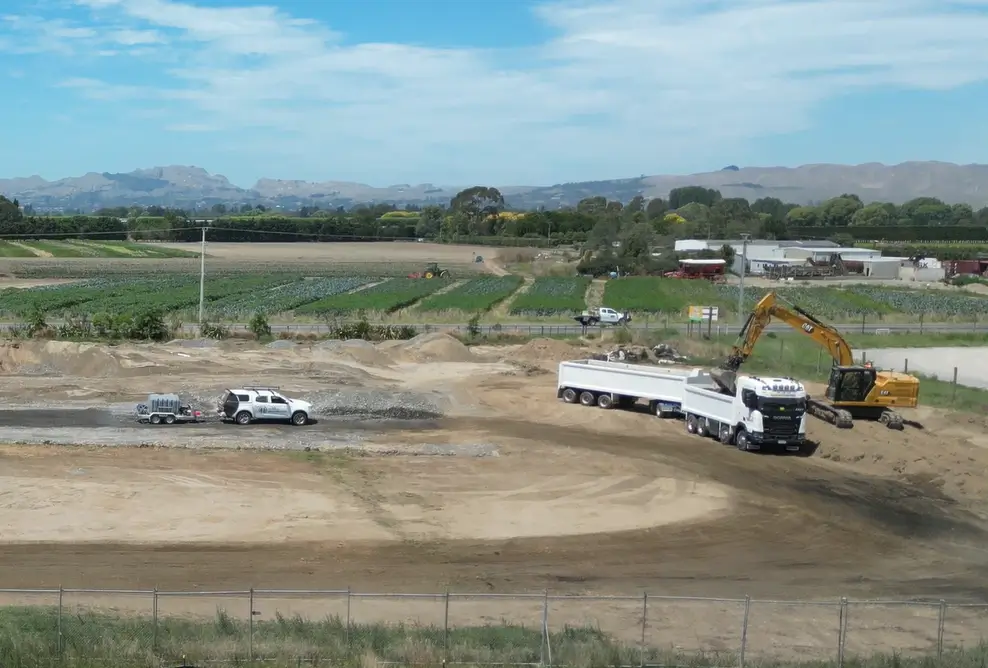
The Decision Is More Straightforward Than You Think
A lot of contractors overthink the water cart decision. They spend weeks comparing brochures, calling around for prices and second-guessing their choice. In practice, the right water cart for most NZ civil and construction work comes down to seven questions. Answer those honestly, and the decision makes itself.
This guide is written for contractors who are actively researching a purchase. It covers what actually matters, what to watch out for, and how to match the machine to your operation rather than to a spec sheet.
1. What Jobs Are You Actually Using It For?
This is the question most buyers skip, and it is the most important one. Water carts do different things depending on how they are configured, and buying on tank size alone without thinking about the job mix is how contractors end up with a unit that does not quite fit their work.
If your main requirement is dust suppression on a roading or civil site, you need volume and a good spray pattern. If you also need high-pressure washdown for machinery, drainage culverts or concrete surfaces, you need a unit with a dedicated water blaster pump as well as a flood jet pump. If you are working on compaction, pipe testing, hot works support or tree watering on subdivision jobs, each of those tasks has slightly different water delivery requirements.
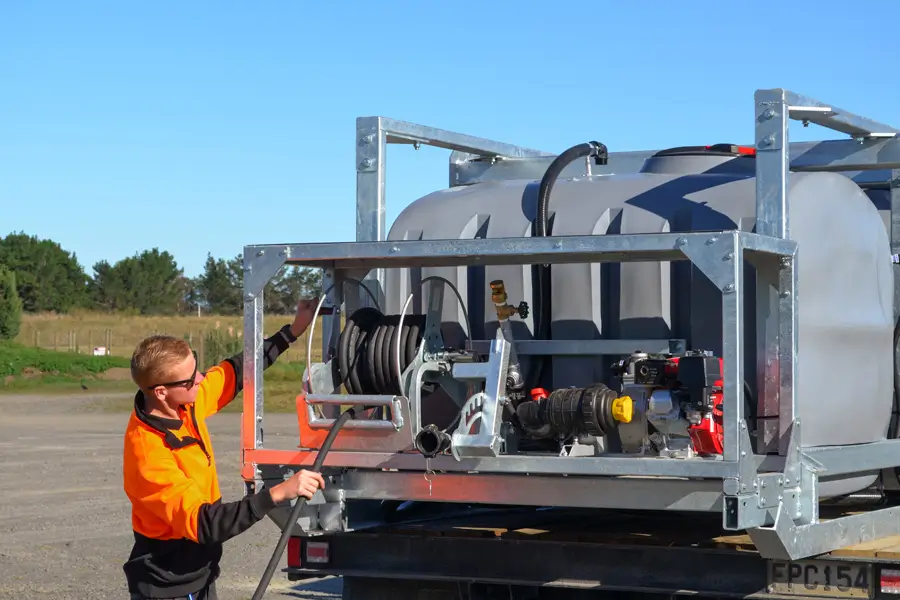
Before you call anyone about price, write down the three or four jobs you will use the water cart for most often. The AquaMaster 2000 is built around exactly this kind of versatility: two independent Honda-powered pumps: a high-pressure water blaster at 3,500 PSI delivering 30 L/min, and a high-volume flood jet pump delivering 120 L/min, from a single 2,000L trailer unit. That combination handles most NZ site requirements without swapping hoses or changing configuration.
2. What Is Your Towing and Site Access Setup?
Trailer water carts need a tow vehicle with adequate capacity. The AquaMaster 2000 requires a minimum 2,500 kg towing capacity, which a standard Toyota Hilux, Ford Ranger or similar work ute handles comfortably. If you are running a smaller vehicle, that rules out most water cart trailers.
Skid-mounted water carts like the AquaMaster 4000 and AquaMaster 6000 sit on a flat deck or tipper truck rather than a trailer, so they do not need a tow hitch. They need a truck with sufficient payload capacity: 5,000 kg or more for the 4000, and 7,000 kg or more for the 6000. If you already run a flat deck truck on site, a skid tank lets you move the unit between vehicles without any additional trailer registration, warrant or insurance.
Site access matters too. A trailer water cart needs a clear tow path to move around the site. A skid tank on a flat deck needs the truck to be able to reach the work area. On tight urban sites and residential projects, this limits your options more than most buyers expect when looking at specs on paper.
3. How Much Water Do You Need on Site?
Tank size is the spec buyers focus on most, but it is not the most important number. What matters is how long the tank lasts between refills given your typical application rate, and whether the refill logistics on your site are practical.
The AquaMaster 2000 at 2,000L is right for smaller sites and crews using the water cart across a range of tasks. It is compact enough to manoeuvre on tight sites and light enough to tow with a standard ute. The AquaMaster 4000 and AquaMaster 6000 suit larger civil or roading operations where the water cart is running more or less continuously for dust suppression across a longer stretch of road or a bigger earthworks area. Both skid tanks include integrated dust suppression nozzles and an optional remote on/off switch for cab-controlled water delivery, which is particularly useful on roading crews managing traffic at the same time.
The other factor is refill access. If your site is remote or the nearest standpipe or tanker fill point is a significant distance away, a larger tank reduces fill run frequency and keeps the crew working. For more on matching tank size to site type, see our guide to best water carts for dust suppression.
4. Does the Water Cart Need to Do More Than Carry Water?
Some contractors need a unit that goes beyond basic water transport. If your work includes high-pressure cleaning alongside dust suppression, you need a machine with a dedicated water blaster pump, not just a flood jet nozzle. That is an important distinction when comparing models and brands.
The AquaMaster 2000 runs two independent Honda-powered pumps: a 3,500 PSI water blaster for high-pressure work delivering 30 L/min, and a high-flow twin impeller pump delivering 120 L/min through the flood jet nozzle for washdown and dust suppression. Both engines are Honda GX series, chosen specifically because they are proven on NZ work sites and easy to get serviced anywhere in the country.
If your crew does night works or early starts and needs water plus power and lighting in one trailer, the SiteMaster 2000 builds on the same 2,000L water cart base and adds a 5kVA generator and a 5.5m LED lighting tower producing 68,000 lumens. That is a different product from a pure water cart, but it is worth knowing about if your work mix includes road maintenance, emergency response or any night shift activity where running three separate pieces of kit on one site is a logistical headache.
5. Should You Hire or Buy?
If you are using a water cart on more than a handful of jobs a year, ownership almost always makes more financial sense than ongoing hire. Hire rates for water carts in New Zealand vary significantly depending on size, the hire company and the region, but once you are using a water cart for ten or more weeks a year the ownership cost typically compares favourably, even before you factor in availability, the time spent organising hire logistics and the reality that hired equipment is not always maintained to the standard you would maintain your own.
The clearest case for hiring is when you have a one-off job that needs a water cart for a short period, and you have no other use for the unit on the horizon. For contractors building a regular site services capability, purchasing a purpose-built unit that fits your work mix is the better long-term investment.
Our Insights article on hire vs buy in NZ covers the full comparison in detail, helping you weigh up long-term asset equity against project-specific flexibility to find the right fit for your fleet.
6. What Are the Compliance Requirements on Your Sites?
Water carts on NZ construction and civil sites are increasingly subject to site-specific compliance requirements. Dust suppression is a consent condition on many earthworks and roading contracts, and failure to maintain adequate dust control can result in site stoppages and consent breach notices from the local authority.
Some sites also require the water cart to support hot works compliance, meaning a water supply positioned within reach of any welding, grinding or cutting activity that generates sparks near combustible materials. WorkSafe expectations around hot works on NZ construction sites include a fire watch with immediate access to a water supply for the duration of the hot works and for a period afterwards.
Knowing your compliance obligations before you buy helps you choose the right configuration. A machine with a high-pressure blaster and a flood jet pump covers both dust suppression and hot works support from a single unit, which simplifies site management and reduces the number of separate plant items you need to track.
How Easy Is It to Maintain and Source Parts?
Contractors dread downtime. A water cart that is sitting idle because a valve seal failed or a pump fitting needs replacing is not just an inconvenience; on a dusty summer site with consent conditions to meet, it is a serious problem.
Before you buy, ask whether parts are available locally and how quickly you can get the machine back to work if something fails in the field. For contractors running jobs in remote areas like the Hawke’s Bay or the Central Plateau, waiting weeks for parts shipped from overseas is not an acceptable risk.
The AquaMaster range is built specifically to avoid this problem. All three models, the AquaMaster 2000, 4000 and 6000, use off-the-shelf components available from NZ suppliers, which means most wear items and replacement parts can be sourced locally without lead times. The pump engines are Honda GX series, chosen in part because Honda has one of the most extensive service networks in New Zealand. If your engine needs attention, there is a qualified service agent within reach of most work sites in the country.
This is worth checking on any machine you consider buying. A low purchase price means less if you are regularly waiting on parts or paying a premium for specialist servicing. For a water cart that is working on site day after day, maintainability is a running cost, not just a purchase consideration.
What to Do Next
If you have worked through those questions and you have a clearer picture of what you need, the next step is to look at the specifications in detail. The AquaMaster 2000 covers smaller sites and mixed-use requirements, the AquaMaster 4000 suits medium to large civil operations on flat deck trucks, and the AquaMaster 6000 is built for the highest-volume dust suppression work where tank capacity and fewer refill stops matter most.
All three are purpose-built rather than adapted from a generic platform, and all three are designed to be used hard on NZ work sites day after day. Get in touch with our team directly and we will ask you the right questions to find the best match for your operation.