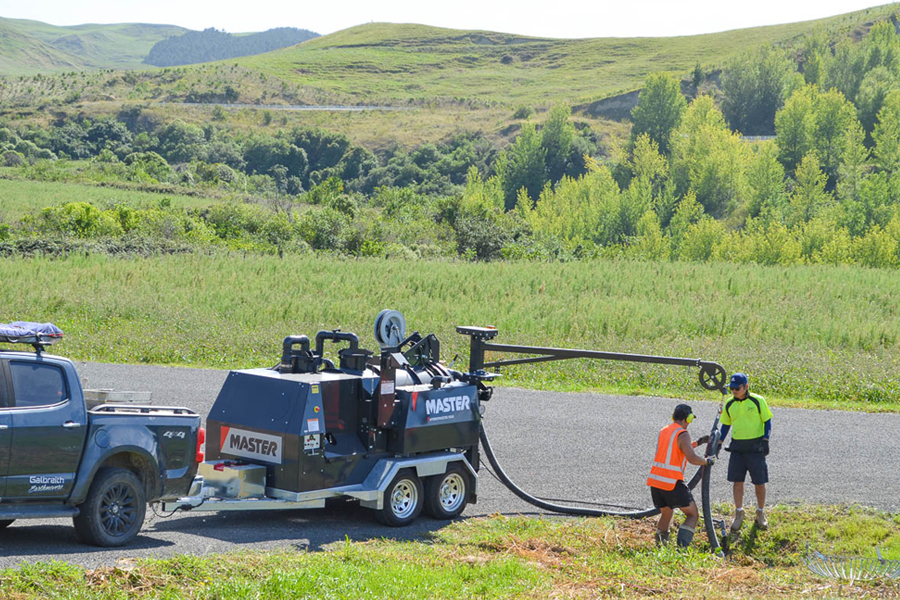
HydroMaster 1000

HydroMaster 1000

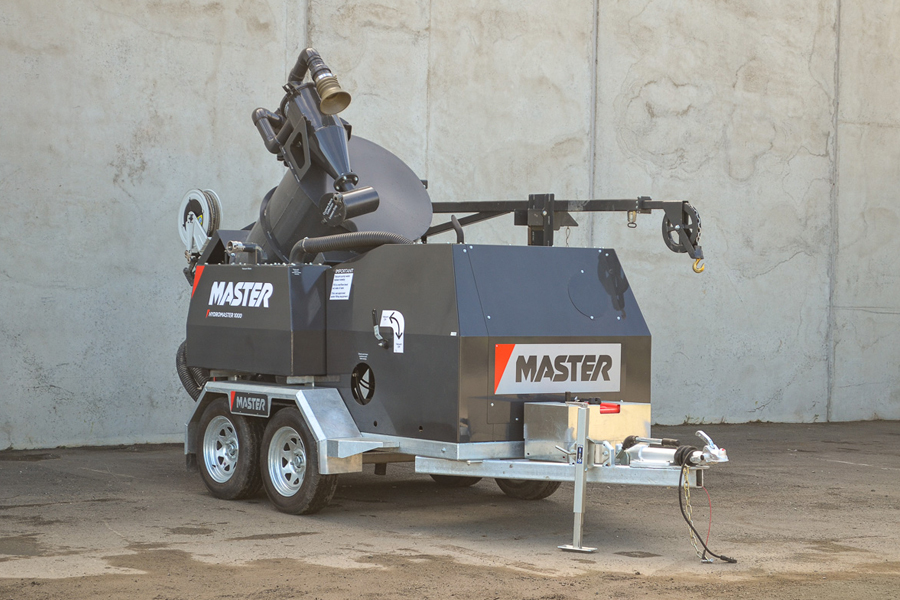
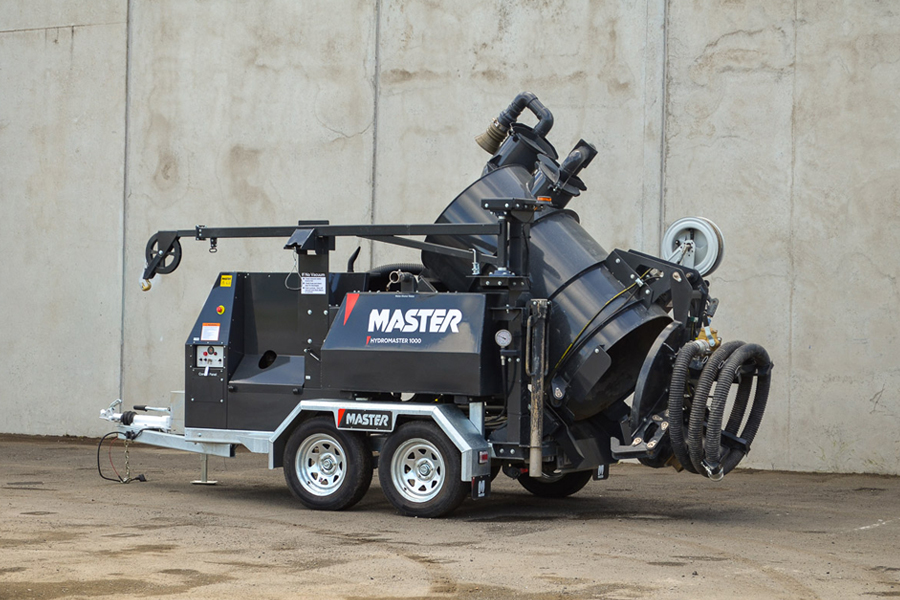
The small trailer unit with big hydrovac truck benefits. The HydroMaster 1000 makes work easier by packing big time functionality into a small but mighty footprint. It’s the quick and easy way to excavate more, with less mess and less fuss.

About the Machine
Photo Gallery
Specifications
Resources
Features & Benefits
Applications
User Stories
FAQs

Compact Trailer Hydrovac for Potholing and Safe Digging on NZ Sites

The HydroMaster 1000 is a compact, trailer mounted hydrovac built for NZ contractors who need truck level vacuum excavation in a towable, ute friendly package. With a 1m3 spoil tank, a 250L water blaster tank and a liquid ring vacuum system, it handles potholing, locating underground services and non-destructive digging without the cost or footprint of a full truck mounted unit.

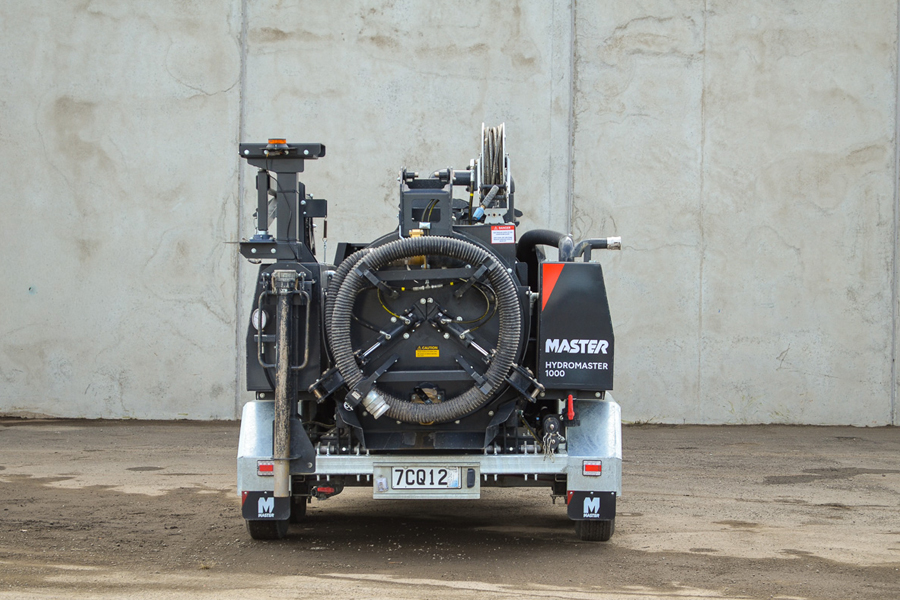
The hydraulically controlled over centre rear door latch (the LatchMaster) lets the operator dump spoils without standing in the firing line. Older screw type latches are prone to leaking on the road and tend to give the operator a face full of spoils when opening. The LatchMaster locks tight, stays sealed in transit, and releases cleanly so the operator stays clear of the load every time.

We’ve done away with the old screw-type latch door that’s prone to leaking on the road and constantly threatens to give the operator a face-full of spoils when opening. Instead, our LatchMaster system uses a hydraulic over-centre door latch that locks the rear door perfectly every time. There’s no vacuum reliance and no mess. Just a perfectly tight seal that stays that way, and when it’s time to open it, there’s no chance of getting covered in mess so the operator gets away cleanly every time.

A telescopic, spring assisted boom takes the weight of the filled suction hose so the operator can focus on placing it precisely. That means less fatigue across long shifts and better control around live services. The HydroMaster 1000 also uses a liquid ring vacuum system, the same technology used in full truck-mounted hydrovacs. Unlike air based trailer hydrovacs that lose suction when the standpipe enters water, the liquid ring system keeps full suction in wet, clay heavy or flooded conditions. That makes it a serious option for stormwater work, drainage clean-outs and post-weather event recovery jobs.

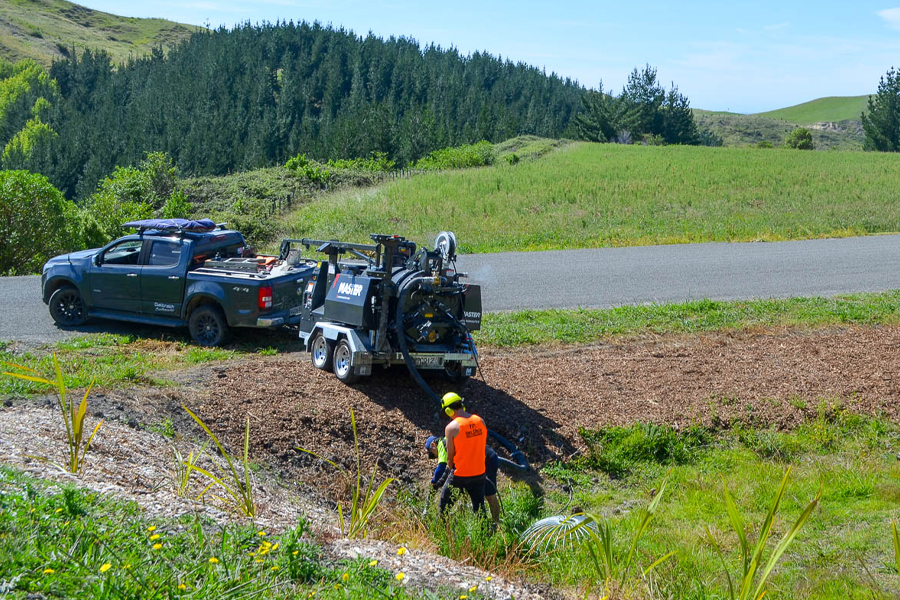
Need vacuum excavation capability without taking on a truck? The HydroMaster 1000 gives smaller civil contractors, utility crews and council maintenance teams the same functional outcome as a truck mounted unit, in a trailer that any 3,500 kg towing capable vehicle can pull onto site. Talk to our team about your typical job mix and we will tell you straight whether it is the right tool for your work.

Specifications

  • VACUUM TANK SPOILS CAPACITY 1 M³
  • DIMENSIONS L/W/H 4.5 x 2.0 x 2.1m
  • TARE WEIGHT (empty) 2410kg
  • SUCTION HOSE SIZE 3”
  • WATER BLASTER WAND LENGTHS 1200 & 2000 MM
  • STANDPIPE LENGTH 1.0 M
  • WATER BLASTER TANK CAPACITY 250L
  • HIGH PRESSURE WATER NOZZLE Turbo Nozzle
  • CONTROLS Electric
  • TOW HITCH COUPLING 1-7/8”
  • WHEEL SIZE 15"
  • Trailer Rated Capacity 3500kg

PDF Downloads

HydroMaster 1000 vs 2000: full specification comparison

Feature HydroMaster 1000 HydroMaster 2000
Format Towable trailer (hydrovac trailer) Skid frame (mounted on flat deck or tipper truck)
Vacuum tank spoils capacity 1 m³ (1,000 L) 2 m³ (2,000 L)
Water blaster tank capacity 250 L 1,000 L (1 m³)
Suction hose size 3" 5"
Standpipe length 1.0 m 1.5 m
Vacuum pump type Liquid Ring Pump (Full Vacuum System) Liquid Ring Pump (Full Vacuum System)
Water blaster wand lengths 1,200 and 2,000 mm 1,200 and 2,000 mm
High pressure water nozzle Turbo nozzle Turbo nozzle
Boom rotation 240 degrees (telescopic, spring-assisted) 270 degrees (remote-controlled)
Controls Electric Electric, remote control
Remote control Not included as standard Included as standard
Emergency stop E-Stop button included E-Stop button included
Rear door system LatchMaster hydraulic over-centre latch LatchMaster hydraulic over-centre latch
Sight glass on spoils tank Included (monitors fill level) Included (monitors fill level)
Hose extensions Self-clearing male couplers on each end 2 m hose extension included
Flashing beacon Included as standard Included as standard
Tow hitch coupling 1-7/8" Not applicable (skid frame, not towable)
Wheel size 15" Not applicable
Trailer rated capacity 3,500 kg Not applicable
Dimensions (L x W x H) 4.5 x 2.0 x 2.1 m 4.6 x 2.2 x 2.15 m
Tare weight (empty) 2,410 kg 3,000 kg
Truck requirement Towable by any vehicle with min 3.500 kg towing capacity (no H2 licence needed) Flat deck or tipper truck with 8,000 kg+ payload capacity (class 2 four-wheel truck)
Loading and transport Towed on 1-7/8" hitch coupling; moves between sites without a dedicated truck Skid-mounted; shifts between any suitable flat deck truck with no fitment required
Typical applications Potholing, trench excavation near services, drainage, residential driveways, tight access urban sites, planting in confined spaces Potholing, trench excavation, drainage and stormwater, foundation exposure, larger urban sites, wet and clay-heavy ground conditions

Which HydroMaster should I choose? Use case decision matrix

Use Case HydroMaster 1000 HydroMaster 2000
Potholing around buried utilities (pipes, cables, fibre) Best fit (Recommended) Best fit (Recommended)
Residential driveway and tight access urban sites Best fit (Recommended) Suitable
Companies with staff that don't have an H2 licence Best fit (Recommended) Not suitable
Sites where truck access is limited Best fit (Recommended) Suitable
Trench excavation near underground services Best fit (Recommended) Best fit (Recommended)
Drainage and stormwater work Best fit (Recommended) Best fit (Recommended)
Foundation exposure on small to medium sites Best fit (Recommended) Suitable
Foundation exposure on larger civil sites Suitable Best fit (Recommended)
Excavation in very wet or clay-heavy ground Suitable Best fit (Recommended)
Larger spoils volume per trip (less frequent emptying) Not suitable Best fit (Recommended)
Fire hydrant or camlock refill on site Best fit (Recommended) Best fit (Recommended)
Hire company fleet requiring no dedicated truck Best fit (Recommended) Suitable
Large infrastructure or civil projects Possible, with limitations Best fit (Recommended)
Urban environments with space constraints Best fit (Recommended) Suitable

HydroMaster vs alternative vacuum excavation options in New Zealand

Consideration HydroMaster 2000 HydroMaster 1000 Generic imported hydrovac
Build quality Purpose-built in New Zealand using premium components and a large diesel engine, in this case an Iveco engine Purpose-built in New Zealand with liquid ring vacuum and hydraulic LatchMaster door for reliable, clean operation Often built to a price point; varies by supplier and age of fleet
Suitability for NZ conditions Designed for New Zealand civil and infrastructure worksites; skid format suits flat deck truck fleets Designed for New Zealand contractors; trailer format suits both small fleets and large fleets requiring a compact unit for smaller jobs, and hire companies without dedicated trucks. Generic specification not tailored to NZ towing rules or compact urban site access requirements
Vacuum performance Liquid ring pump with full vacuum system; works in wet and clay-heavy ground; standpipe can be fully submerged Full vacuum system with liquid ring pump; maintains suction in water and sludge without an air gap Performance varies; air-based systems lose efficiency in very wet or clay-heavy ground conditions
Transport requirement Flat deck or tipper truck with 8,000 kg payload capacity Towable by any vehicle with 3,500 kg towing capacity; no H2 licence required Typically requires a dedicated truck; H2 licence usually required
Site access Fits class 2 four-wheel truck; suitable for compact urban sites and residential driveways Towable trailer; highly manoeuvrable on tight access sites and residential driveways Larger truck-mounted units struggle with tight access sites and residential driveways
Operator requirement Single operator with remote control and E-Stop; suitable for most crews, but can also be operated by more than one person. Single operator setup; LatchMaster door system allows safe dumping without assistance, but can also be operated by more than one person. Often requires two operators; standard door systems carry risk of spillage on opening
After-sales support NZ-based support, parts and servicing through Master Machinery NZ-based support, parts and servicing through Master Machinery Often limited or no local support; parts may need to be sourced internationally
Long-term cost Higher upfront investment; lower cost per hour over the life of the machine with no expensive filters Higher upfront investment; lower cost per hour with no expensive filters and simplified servicing Similar upfront cost; higher risk of downtime and component failure over time, and generally more complex to operate than HydroMaster machines built for NZ contractors.
Customisation Talk to our sales team to configure a HydroMaster to your requirements. Talk to our sales team to configure a HydroMaster to your requirements. Take-it-or-leave-it specification in most cases
Resale value Strong resale due to brand recognition and proven build quality in NZ Strong resale due to brand recognition and proven build quality in NZ Weaker resale on generic imported units
Best for Civil crews on flat deck trucks; larger urban infrastructure; projects needing bigger spoils capacity Hire companies, small to medium contractors, owner-operators needing tight access and trailer mobility Buyers prioritising the lowest possible upfront cost or one-off project requirements

Features & Benefits

Built for You In Mind

TRAILER BASED

The HydroMaster 1000 is highly mobile and maneuverable. It can be easily towed and helps save operators money and complications, with no H2 licensed driver needed for transporting from site to site.

BALANCED WHEN EMPTY AND FULL

LIQUID RING VACUUM

USER FRIENDLY

EASY MAINTENANCE

SELF-CLEARING

240 DEGREE BOOM ROTATION

INDEPENDENT VACUUM ENGINE

REAR HOSE RACK

What Can You Use the HydroMaster 1000 For?

Potholing Around Underground Services

Before any mechanical digging begins on a project with buried infrastructure, the ground needs to be confirmed. The HydroMaster 1000 is used daily by civil and utility crews across NZ to expose water mains, gas lines, power cables, and fibre conduits safely and precisely, without the risk of a strike that a mechanical excavator cannot avoid. The 240-degree boom rotation and 3-inch suction hose let a single operator work efficiently across multiple pothole locations in a single shift, making it the preferred first step on subdivision connections, road upgrades, and utility maintenance contracts.

Read More

Residential & Tight-Access Excavation

Many NZ residential jobs simply cannot be reached by a truck-mounted hydrovac. The HydroMaster 1000 tows behind a standard ute and fits through a residential gate, making it the right tool for new connections, drain repairs, and foundation exposure in driveways and yards where larger equipment would damage the surface or fail to fit. It is also used for planting large trees and specimen shrubs in confined urban spaces where digging by hand is impractical but an excavator or digger is too large or risks damaging underground services.

Read More

Stormwater & Drainage Clean-Outs

Blocked sumps, silted catch basins, and debris-filled drainage channels are routine maintenance tasks for councils and roading contractors across NZ. The HydroMaster 1000 uses its liquid ring vacuum system to extract sediment, organic matter, and debris from these structures cleanly and without the mess associated with manual methods. Unlike air-based vacuum pump trailer units that lose suction when the standpipe enters water, the liquid ring system maintains full extraction performance in wet and flooded conditions, which is essential for NZ stormwater work.

Read More

Underground Service Location Before Earthworks

On any NZ project governed by utility owner requirements or WorkSafe guidance on working near underground assets, exposing services before earthworks begin is a compliance requirement, not just good practice. The HydroMaster 1000 handles the exposure phase precisely: the operator breaks up compacted soil with the high-pressure water wand, and the vacuum draws spoils directly into the sealed tank. No spoil piles. No dust. No surface damage beyond the excavated area.

Read More
Jonty
Allways Hire,
"THE BEST OF BOTH WORLDS"

Frequently asked questions

What is the difference between the HydroMaster 1000 and the HydroMaster 2000?

The HydroMaster 1000 is trailer mounted with a 1m3 spoil tank and a 250L water tank, designed to be towed behind a 3,500 kg towing capable ute and operated by smaller civil and utility crews. The HydroMaster 2000 is skid mounted with a 2m3 spoil tank and a 1,000L water tank, designed to sit on a flat deck or tipper truck for higher volume jobs. Both use a full vacuum system that works in wet conditions, but the HydroMaster 1000 suits crews who do not want to commit a truck to vacuum excavation full time.

What can the HydroMaster 1000 be used for?

Potholing around buried utilities, locating underground services before excavation, drainage and stormwater clean outs, sump cleaning, residential driveway work where a larger truck cannot fit, and post storm or flood recovery where wet ground rules out air based hydrovacs. The 240 degree boom rotation and 3 inch suction hose suit small to mid size jobs typical of council and utility maintenance work.

What vehicle do I need to tow the HydroMaster 1000?

Any vehicle with a minimum 3,500 kg towing capacity and a 1-7/8 inch tow ball. A Toyota Hilux, Ford Ranger, Isuzu D Max or similar work ute will tow it comfortably when properly braked. The trailer is balanced empty and full, so it tows predictably whether you are heading to site or returning loaded with spoils. Always confirm your specific vehicle and tow bar rating before towing.

How does the liquid ring vacuum system work, and why does it matter?

A liquid ring vacuum uses a rotating ring of water to create suction, the same technology used in full truck mounted hydrovacs. Unlike air based trailer units, it does not need an air gap to maintain suction, so the standpipe can be fully submerged in water and still extract efficiently. That matters in NZ where wet ground, clay heavy soils, and stormwater jobs are common. The system also tolerates accidental water ingestion without losing performance.

How is the spoil tank emptied, and is it safe to operate solo?

The spoil tank empties through a hydraulically controlled rear door (the LatchMaster), which seals tight in transit and releases cleanly when tipping. The latch system stops the operator getting hit with the load when the door opens, which is a common issue on other trailer hydrovacs. Combined with electric controls and the 240 degree boom rotation, the HydroMaster 1000 is designed to be operated safely by one person on site.

Enquire Now

Simply fill out your details and our team will be in touch

Key Contacts

Jeremy

Business Development

"*" indicates required fields

View more machines