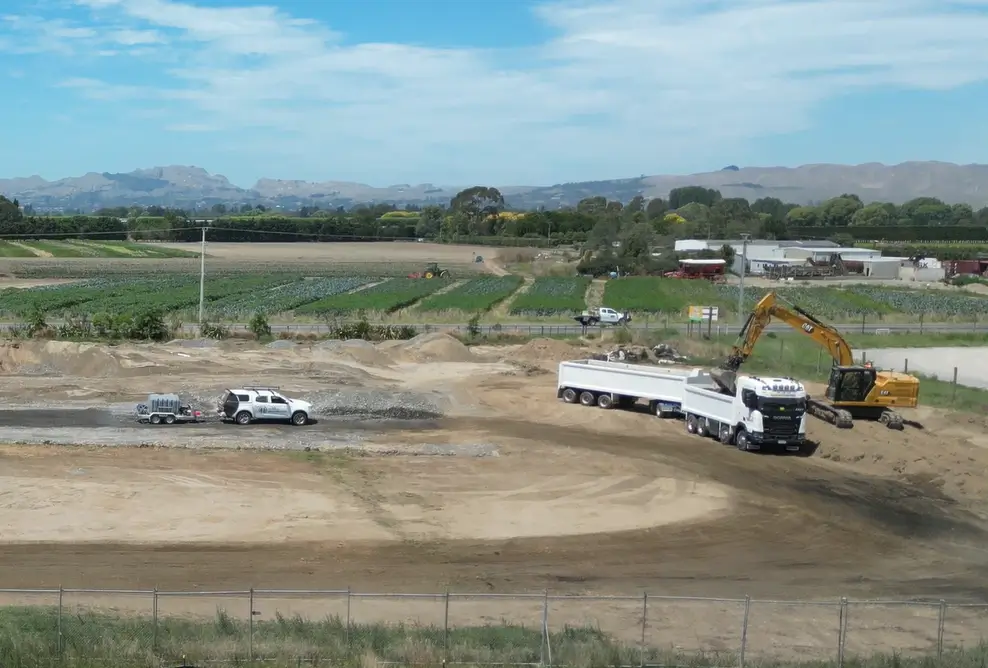
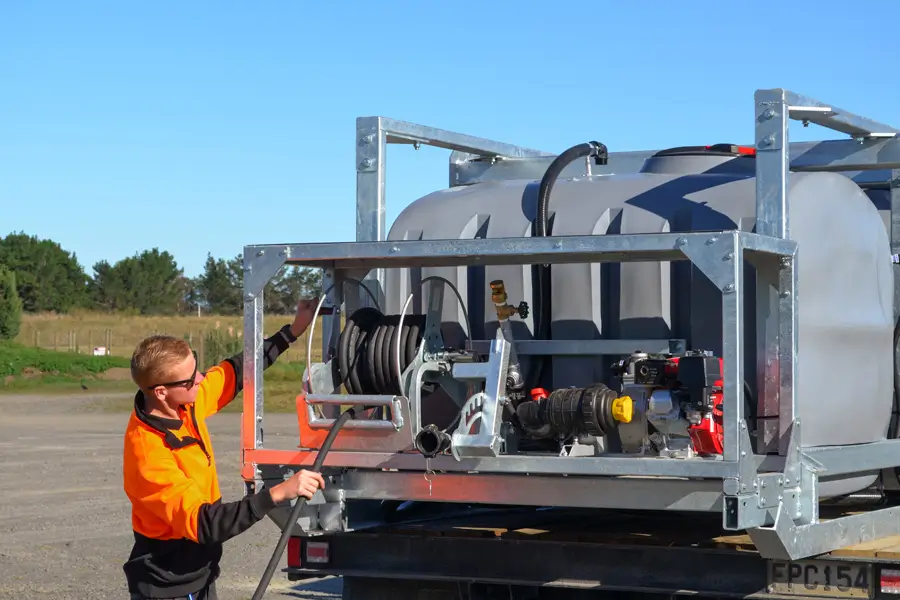
Ask most people what a water cart does on a construction site and they will say dust suppression. That is one of the jobs, and it is an important one. But if dust suppression is the only use you are getting out of your water cart, you are leaving a lot of value sitting on the trailer.
A well-specified water cart is one of the most versatile pieces of equipment on a NZ civil or construction site. This guide covers the top seven uses, what you actually need for each one, and which AquaMaster model is best suited to the job.
1. Dust Suppression
Dust suppression is the job most contractors associate with water carts, and for good reason. On NZ civil, roading, and earthworks projects, active dust management is a legal requirement, not a preference. WorkSafe New Zealand identifies construction dust as a respiratory health hazard, and many council resource consent conditions require active dust control as a condition of works.
For dust suppression to work, you need consistent water application across the affected surface, enough tank capacity to maintain coverage throughout the working day without constant interruptions, and a pump flow rate that delivers water at a volume that actually binds dust to the surface rather than just wetting the top layer momentarily.
Recommended: AquaMaster 4000 for medium sites and road corridor works; AquaMaster 6000 for large earthworks and high-volume suppression.
2. Compaction Support
Compaction is one of the most technically important tasks on civil and subdivision projects, and water plays a direct role in achieving the required result. Soil moisture content must be within a specific range for effective compaction. Too dry, and the particles do not bind properly. Too wet, and you risk instability and displacement.
A water cart allows operators to apply water accurately to the material being compacted, bringing the moisture content up to the right level before each pass of the compactor. This is standard practice on bulk earthworks, trench backfill, and subdivision pavement construction across New Zealand.
Getting this right the first time avoids expensive rework, failed compaction tests, and project delays. Having a dedicated water cart on site for compaction support is one of the more straightforward ways to protect the quality of the finished result.
Recommended: AquaMaster 2000 for lighter compaction and subdivision work; AquaMaster 4000 for higher-demand bulk earthworks compaction.
3. Hot Works Compliance
Any work involving grinding, welding, cutting, or any activity that generates sparks or heat near combustible materials requires a water source to be immediately accessible. This is not best practice: it is a specific health and safety requirement under NZ legislation.
The practical reality on many construction sites is that a fixed hose connection is not always close enough to the hot works zone, or the site infrastructure simply does not support it. A water cart positioned directly adjacent to the work area solves this problem cleanly.
For hot works compliance, the key requirement is immediacy: the water needs to be right there, ready to deploy without any setup or delay. A compact trailer unit that can be towed to the exact location of the hot works and left in position for the duration of the work is the most practical solution for most NZ sites.
Recommended: AquaMaster 2000 with its high-pressure capability and compact footprint.
4. Equipment and Site Washdown
Plant and equipment on NZ construction sites accumulate mud, concrete, aggregate, and other material rapidly. Keeping equipment clean is not just about appearance: it extends the service life of machines, reduces wear on hydraulic and mechanical components, and prevents tracking contaminated material off-site, which is a specific obligation under many NZ resource consent conditions.
A water cart with high-pressure capability handles equipment washdown efficiently, from ute tyres and buckets at the site exit point through to full plant cleaning between jobs or at the end of a working day.
The AquaMaster 2000 is particularly well-suited here. Its 3500 PSI water blaster and 30m high-pressure hose give it genuine cleaning power for concrete, packed mud, and heavy site contamination, well beyond what a garden hose or site tap can deliver.
Recommended: AquaMaster 2000 with its dual-pump system and 3500 PSI blaster pressure.
5. Trenching and Backfill Support
Trenching work requires water at multiple points in the process. During excavation, dust control around the trench and on access tracks keeps the site compliant. During backfilling, water application to each layer of material supports the compaction process and helps achieve the required density.
For trench work near existing underground services, a water cart also provides an immediately accessible water supply for equipment cleaning and for site washdown around exposed service infrastructure.
The key for trenching applications is having a unit that can be repositioned as the trench progresses down the alignment, without disrupting the dig. A compact, towable unit that follows the work is far more practical than a large static tank that needs heavy equipment to move. Recommended: AquaMaster 2000 for its mobility and compact footprint along trench runs.
6. Landscaping and Tree Watering
Subdivision projects and civil contracts often include landscaping, grass establishment, and revegetation obligations as part of their consent conditions. Newly seeded embankments, planted medians, and landscaped areas around stormwater infrastructure need consistent moisture to establish properly, particularly over the first summer season.
A water cart provides a reliable, mobile water supply for these areas without relying on permanent irrigation infrastructure that may not yet exist on a new subdivision. It can cover large areas quickly, reach slopes and embankments that fixed sprinklers cannot, and be repositioned as establishment priorities shift across the site.
The high-flow washdown hose with adjustable nozzle can switch from a jet to a fan spray, making it suitable for tree watering.
Recommended: AquaMaster 2000 for subdivision landscaping and tree establishment work.
7. Onsite Water Supply for Concrete and Pipe Testing
Concrete work in remote locations and pipe testing after new installation both require a reliable on-demand water supply. On sites where mains water is not available or the connection point is not close to the work, a water cart provides a self-contained supply that keeps the job moving.
Concrete mixing on remote sites, culvert construction, and pipe pressure testing all require volumes and flow rates that a water cart handles easily. Once the work is done, the same unit can switch to another task on site without any reconfiguration.
This versatility is one of the most underappreciated aspects of a well-specified water cart: it is not a single-purpose machine, and on a busy site it can be earning its keep across multiple tasks in a single day.
Recommended: AquaMaster 2000 for remote concrete work and pipe testing; AquaMaster 4000 where higher volume is required.
The contractors who get the most from their water cart are the ones who plan for multiple uses from day one. A unit that handles dust suppression, compaction, washdown, and hot works compliance is a significantly better return on investment than one that sits in the corner between dust events.
If you are specifying a water cart for an upcoming project or looking to add a unit to your fleet, the Master Machinery teamcan help you match the right AquaMaster model to your actual site requirements, not just the most obvious use case.