Every winter, council maintenance teams and roading contractors across New Zealand work through the same list. Sumps full of silt. Cross culverts choked with gravel, leaf litter and the odd traffic cone. Catch pits that stopped draining properly two storms ago and are now backing water across a live traffic lane.
The work is routine, it is time sensitive, and the method you use to clear it decides how long the job takes and how much of the material ends up back on the road. This article looks at where a compact hydrovac trailer fits into NZ drainage and stormwater maintenance, why jetting on its own often leaves the job half finished, and what to look for in a machine that has to work in wet ground.
What a Drainage Clean-Out Job Actually Involves
Most drainage maintenance jobs come down to three things: breaking up material that has compacted in place, getting that material out of the structure, and taking it away without spreading it across the surrounding surface.
The material itself varies more than people expect. A roadside sump might hold fine silt and sand with a layer of organic matter on top. A rural culvert can be packed with gravel, clay and vegetation. A stormwater pit near a construction site collects washed concrete slurry that sets harder than the ground around it. Each of these behaves differently under water pressure, and each needs a different amount of force to shift.
The second half of the job is the part that decides how long the crew is on site: removal. Whatever you break loose has to go somewhere, and if it is not being extracted as you go, it settles again further down the system or ends up shovelled into a bin by hand.
Why Jetting on Its Own Does Not Finish the Job
High-pressure jetting is very good at what it does. It cuts through blockages, clears pipe runs and restores flow quickly. On a straightforward blocked line, it is often all you need.
The limitation shows up on structures rather than pipes. When you jet a sump, a catch pit or a silt trap, the material is dislodged but it is still in the system. It either settles again once the water calms down, or it moves downstream and becomes someone else’s blockage in six months. On maintenance contracts where the same assets come back around on a cycle, that is a job you end up doing twice.
Combining pressurised water with vacuum extraction changes the outcome. The water breaks the material up, and the vacuum lifts it straight into a sealed spoil tank on the machine. The structure is emptied rather than stirred, the crew can see the base of the sump to confirm it is clear, and nothing is left to migrate through the network.
That is also why hydro excavation has become the default approach for exposing drainage services before a repair. The same principles that make it safer around fibre and gas make it precise around existing pipework. We cover that in more detail in Why Non-Destructive Digging Matters for Utilities.
The Wet Ground Problem: Liquid Ring vs Air Based Vacuum
This is the single most important specification on a drainage machine, and it is the one most buyers do not ask about until after they have bought.
There are two vacuum system types commonly used on trailer hydrovacs in New Zealand. Air based systems, sometimes called blower systems, move air to create suction. They work well in dry material, but they lose performance the moment the standpipe enters water, because the system depends on an air gap to keep working. On a stormwater job, the standpipe is in water almost immediately.
Liquid ring vacuum systems use a rotating ring of water to generate suction. There is no air gap required, so the standpipe can be fully submerged and the machine keeps extracting. It is the same technology used in full truck-mounted hydrovacs, and it is the reason a liquid ring trailer unit can be dropped straight into a flooded sump or a saturated trench and keep working.
For NZ conditions this matters more than it might elsewhere. Clay-heavy soils, high water tables through winter and a maintenance workload that peaks immediately after heavy rain all mean the machine will be working wet far more often than dry. Both the HydroMaster 1000 and the HydroMaster 2000 use liquid ring vacuum systems for exactly this reason, and neither has expensive filters to replace as part of that setup.
Where a Compact Hydrovac Earns Its Keep
Sump and Catch Pit Cleaning
Service pits, access chambers and in-ground sumps fill with sediment steadily and lose capacity long before anyone notices. A trailer hydrovac lets one operator break up compacted sludge with the water wand and extract it into the tank in a single pass, leaving the structure clean and its full capacity restored. For councils managing a scheduled asset maintenance programme, the ability to clear several pits in a shift without a truck tied up is the practical advantage.
Culvert and Cross Culvert Clearing
Culvert cleaning is one of the more searched drainage jobs in New Zealand, and it is one where hydrovac and high-pressure water complement each other well. Water cuts into packed silt and debris, the vacuum removes it, and the culvert is cleared without an excavator working over a fragile road shoulder. On smaller rural culverts, a combination of a high-pressure water blaster and a vacuum unit will handle the work a truck-mounted machine cannot physically reach. Downer’s crews use an AquaMaster 2000 for culvert cleaning work, which gives a good picture of how the high-pressure side of that job is handled.
Post Storm and Flood Recovery
After a significant weather event, the drainage network needs clearing fast and the ground is saturated. This is the condition that stops air based units working properly and it is where a liquid ring machine has a clear advantage. Recovery crews use compact hydrovac trailers to clear blocked culverts, empty flooded sumps and restore drainage function without waiting for a truck-mounted unit to become available, which after a regional event can be a wait of days rather than hours.
Exposing Drainage Services Before Repair
When a pipe has failed and the repair crew needs to get to it, mechanical digging near an existing line risks turning a small repair into a bigger one. Vacuum excavation exposes the pipe cleanly, confirms the depth and condition before anyone commits to a repair method, and keeps the excavation tight enough that reinstatement is minimal.
Slot Trenching for New Stormwater Connections
Where a new connection has to be made alongside existing services, a narrow slot trench cut with water and vacuumed out gives a clean, precise excavation without disturbing what is already in the ground. The spoil goes straight into the tank, so the work area stays clear and the reinstatement footprint stays small.
Single Operator Work and Why It Matters for Council Crews
Most drainage maintenance is small-crew work. A two-person team covering a district maintenance contract cannot afford to have both people tied up on one sump.
A compact hydrovac designed for single-operator use changes the maths on that. A boom that takes the weight of the filled suction hose means the operator is placing the hose rather than holding it up, which matters over a full shift. Electric controls keep the operating position simple. And the way the spoil tank empties is a genuine safety consideration: older screw-type rear doors are prone to leaking on the road and to giving the operator a face full of spoil when they open. The hydraulic over-centre latch used on the HydroMaster range seals in transit and releases cleanly with the operator standing well clear.
Spoil Handling and Disposal
Whatever comes out of a sump has to be disposed of correctly, and drainage spoil is not always clean fill. Sediment from road drainage carries hydrocarbons, heavy metals and whatever else has washed off the carriageway. Plan the disposal route before the job, not after the tank is full.
A sealed spoil tank helps here in a way that a bin on the back of a ute does not. The material is contained from the moment it leaves the structure until it is discharged at an approved disposal point, there is no spillage in transit, and there is a clear chain of handling if a client or council asks how the material was managed.
The other practical consideration is tank size against travel distance. A 1 m3 tank clears a lot of sumps, but if your disposal point is 40 minutes away, the number of trips per day becomes the thing that sets your productivity, not the machine.
The HydroMaster 1000: Built for the Wet Work
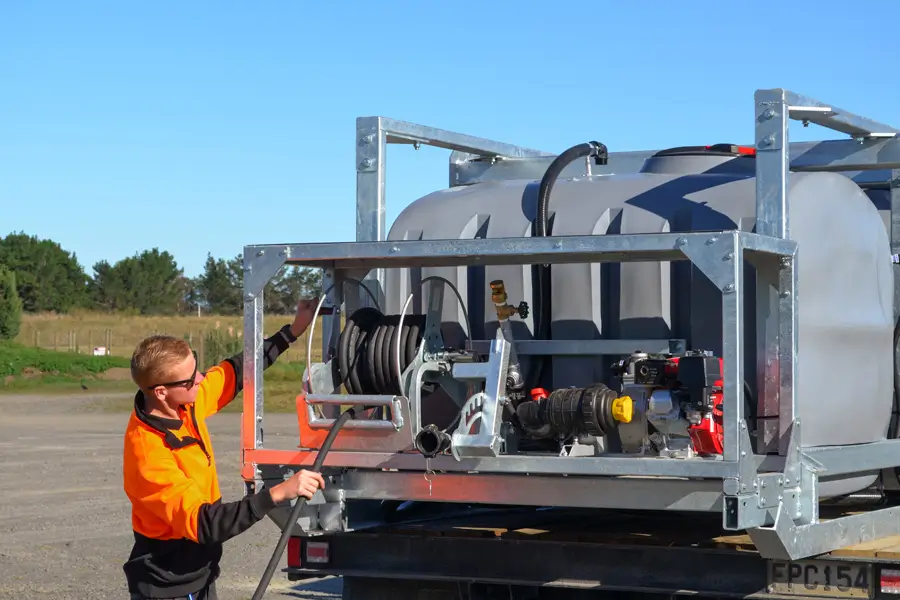
The HydroMaster 1000 is a trailer-mounted hydrovac built for exactly this type of work: small to mid-size drainage, stormwater and potholing jobs where a truck-mounted unit is either unavailable, too large or hard to justify.
Key specifications:
Vacuum tank spoils capacity: 1 m3
Water blaster tank capacity: 250L
Suction hose size: 3 inch, with self-clearing male couplers on each end so the hose can be reversed to clear a blockage
Liquid ring vacuum pump, full vacuum system, no filters to replace
240 degree telescopic spring-assisted boom
Dimensions: 4.5 x 2.0 x 2.1 m, tare weight 2410 kg
Trailer rated to 3500 kg, can be towed on a standard Class 1 car driver licence, provided the tow vehicle’s Gross Combination Mass (GCM) and towing capacity allow it.
The towing point is worth sitting with for a moment. Because it tows behind a standard work ute, the machine goes to site with the crew that is already going there. There is no truck to allocate, no separate driver licence class to organise, and no waiting for a vehicle to come free. For a council maintenance team or a small civil contractor, that is often the difference between owning vacuum excavation capability and hiring it in when things are already urgent.
When to Step Up to the HydroMaster 2000
The HydroMaster 2000 is the skid-mounted option, sitting on a flat deck or tipper truck with a 2 m3 spoil tank, a 1000L water tank and a 5 inch suction hose. The larger spoil capacity means fewer trips to the disposal point, which is the deciding factor on high-volume work or where the disposal site is a long way from the job.
It also suits crews already running a suitable flat deck truck, since the skid frame moves between vehicles without any fitment work. If your drainage work is a regular part of a larger civil operation rather than a maintenance round, that is usually the better fit.
Quick Reference: Matching the Machine to the Job
Job type
Best fit
Sump and catch pit cleaning on a maintenance round
HydroMaster 1000
Rural and roadside culvert clearing
HydroMaster 1000
Post storm and flood recovery in saturated ground
HydroMaster 1000 or 2000
Residential and tight access drainage work
HydroMaster 1000
Exposing drainage services before repair
HydroMaster 1000 or 2000
High-volume spoil, long haul to disposal
HydroMaster 2000
Crews without an H2 licensed driver
HydroMaster 1000
Larger civil sites with a truck already allocated
HydroMaster 2000
Getting Drainage Capability Into Your Own Crew
If your team is currently hiring in vacuum capability for drainage work, the first thing worth doing is counting the jobs. Most councils and maintenance contractors are surprised by how many sump, culvert and pit clean-outs they handle in a year once they add them up, and that number is what decides whether ownership makes sense against ongoing hire.
The second thing is being honest about ground conditions. If most of your drainage work happens in the wet, which in New Zealand it usually does, the vacuum system type matters more than the tank size.
Talk to our team about the jobs your crew handles most often and we will tell you straight whether the HydroMaster 1000 is the right machine for that work mix, or whether you would be better served by the HydroMaster 2000.