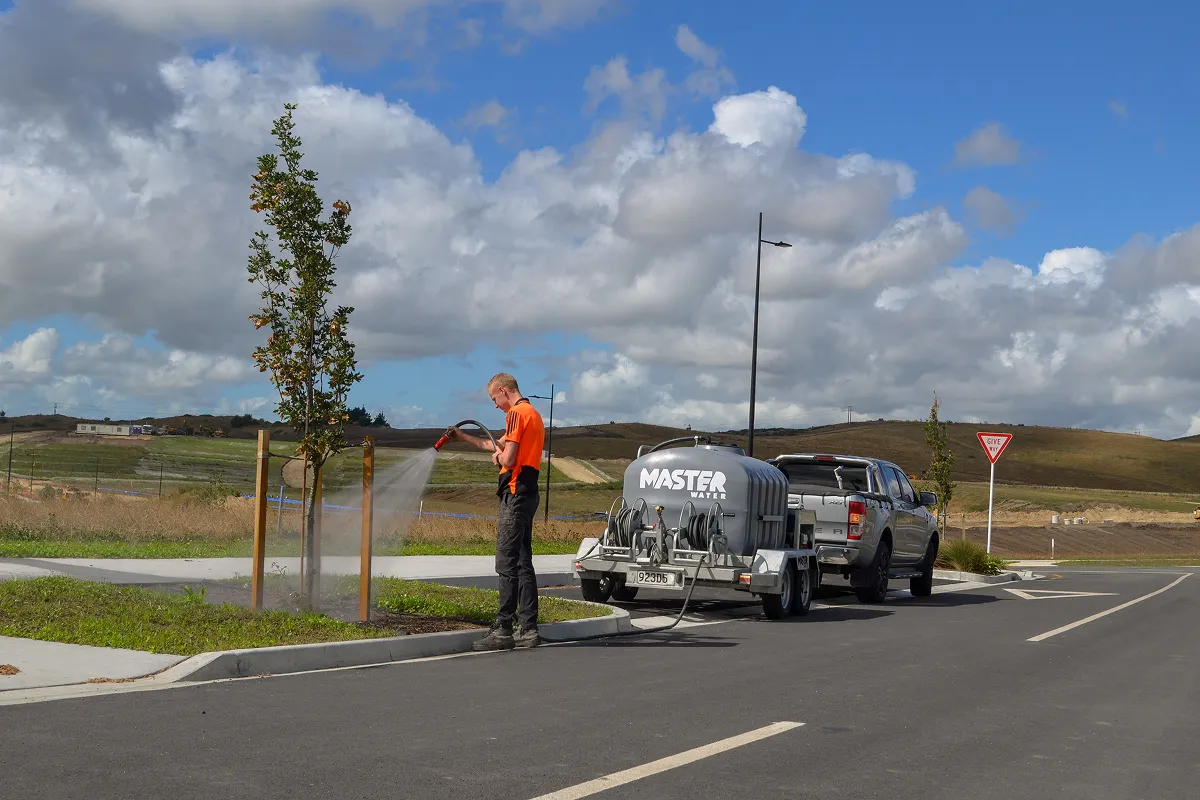
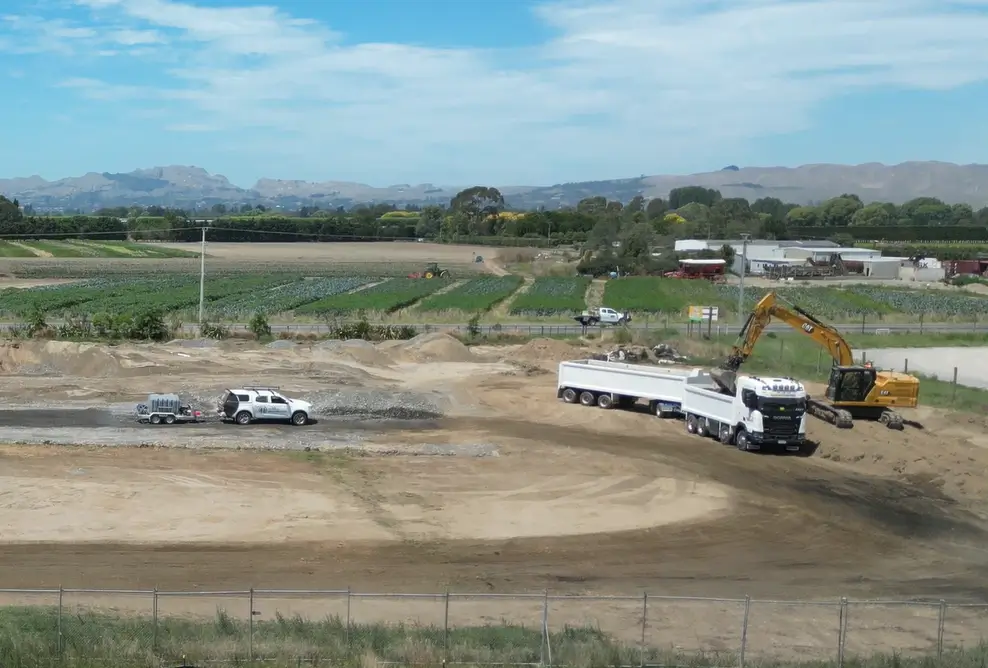
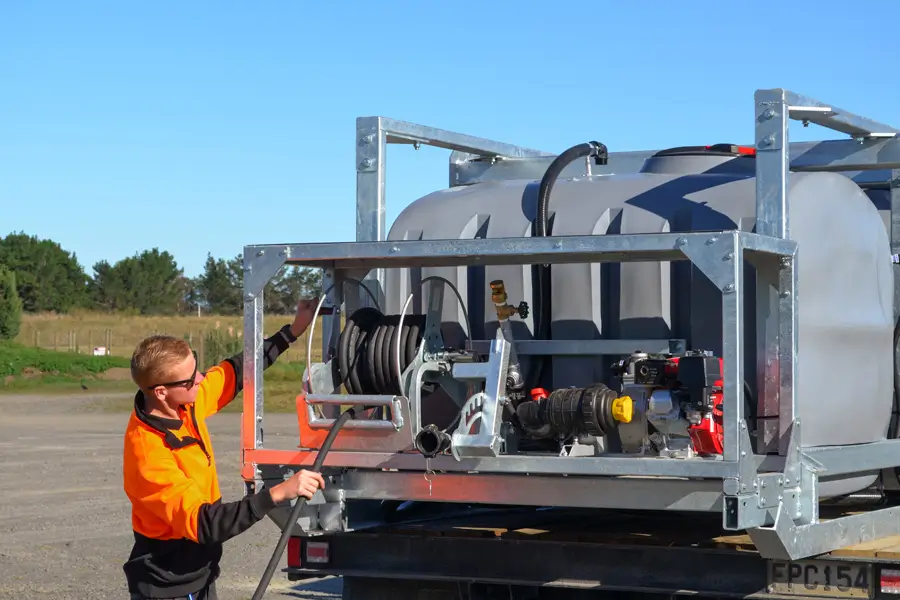
When a NZ construction or civil project needs a reliable water supply, two options come up most often: a purpose-built water cart (typically a trailer or skid-mounted unit) and a water truck (a vehicle with an integrated tank). Both can get water to the job. The question is which one makes more sense for your specific project, site, and budget.
This guide runs through the key differences across cost, mobility, capacity, compliance, and day-to-day practicality to help NZ contractors make the right call.
What Is a Water Cart?
A water cart, in the New Zealand context, is typically either a trailer-mounted water unit or a skid-mounted tank designed to be transported on the back of a truck or flat deck. It is a standalone piece of equipment, separate from any specific vehicle, which gives it some important practical advantages.
The AquaMaster range from Master Machinery includes three water cart options:
A water truck (sometimes called a water tanker) is a purpose-built vehicle with a fixed water tank as part of the truck itself. They range from small rigid trucks with 4,000L to 6,000L tanks through to large articulated tankers with 20,000L or more capacity.
Water trucks are common on large roading and earthworks projects, particularly in situations where very high water volumes are needed continuously throughout the working day.
Cost: Purchase, Operating, and Running Costs
Purchase Price
Water trucks are significantly more expensive to purchase than a comparable water cart. A quality second-hand water truck can range from $80,000 to well over $200,000 depending on capacity and specification. New trucks are higher still.
A purpose-built water cart like the AquaMaster range sits at a fraction of that cost, making it accessible to smaller contractors, owner-operators, and businesses that want a dedicated water supply unit without a major capital commitment.
Running and Compliance Costs
Water trucks are registered motor vehicles. They require a current WOF, road user charges (RUC), commercial vehicle compliance, and a licensed driver. If the truck needs to travel on public roads, all of these add cost and administrative overhead.
A trailer water cart requires no WoF beyond trailer registration and can be towed by a vehicle the contractor already owns. A skid-mounted water cart sits on the back of an existing truck and adds no ongoing vehicle compliance cost of its own.
Maintenance
Maintaining a water truck means maintaining the truck, the engine, the drivetrain, and the water system. That is two complex systems in one unit. When either component fails, the whole unit is out of action.
A standalone water cart has a much simpler mechanical profile. The pump engine is such a Honda GX200, well-supported across New Zealand, and the unit is not dependent on a specific vehicle to operate.
Mobility and Site Access
This is where water carts often have a clear practical advantage for typical NZ civil and construction projects.
Getting Into Tight Sites
Water trucks are large. On subdivision projects, residential builds, confined earthworks areas, and any site with limited turning space or low overhead clearance, a large water truck can create as many problems as it solves.
A trailer water cart like the AquaMaster 2000 can be towed behind a standard ute, pulled along access tracks, and positioned close to the work area without becoming a site obstacle. For sites where access is the primary constraint, a trailer unit is often the only practical option.
Repositioning During the Day
On active construction sites, the area needing water changes throughout the day as work progresses. Dust suppression moves along the road corridor. Compaction work shifts to a new area. Trenching progresses further down the alignment.
A water cart can be towed or transported to another area and back in service in minutes. . A water truck is a more deliberate operation that typically requires a dedicated driver and more coordination to move.
Multi-Vehicle Flexibility
A skid-mounted water cart like the AquaMaster 4000 or 6000 can be moved between trucks as needed. If one vehicle is out of service, the water cart goes on a different truck and work continues. A water truck is a single asset, and when the truck breaks down, the water supply stops with it.
Capacity: How Much Water Do You Actually Need?
Water trucks win on raw capacity. If you are managing dust suppression across a 10km roading corridor or running high-volume earthworks on a very large site, the 15,000L or 20,000L capacity of a large water tanker provides run time that a 4000L or 6000L water cart simply cannot match.
But for the vast majority of NZ civil and construction projects, that volume is more than is needed, and carrying unnecessary capacity means unnecessary cost.
For most NZ applications:
Small to medium sites, subdivisions, and residential construction: 2000L to 4000L is adequate
Medium civil sites, road corridor works, and compaction: 4000L to 6000L covers a full day’s work with fewer refills compared to a smaller trailer water cart.
Large earthworks, long road projects, and high-volume suppression: this is where a water truck or a high-cycle water cart setup makes practical sense
For most owner-operators and small to medium contractors, an AquaMaster 4000 or 6000 provides the run time needed without the capital and operating cost of a water truck.
Compliance and Health and Safety
Both water carts and water trucks can meet NZ dust suppression, hot works compliance, and site water supply requirements. The key is having the right unit for the scope of the job.
For smaller sites where water needs are moderate and access is tight, a water cart is often the more practical compliance tool: easier to position exactly where the compliance requirement applies (for example, adjacent to hot works), faster to deploy, and simpler to operate.
For high-volume compliance requirements on large sites, a water truck offers the run time to maintain continuous suppression across a larger area.
Quick Comparison: Water Cart vs Water Truck
Factor
Summary
Purchase cost
Water cart is significantly lower capital cost
Running cost
Water cart has lower compliance and maintenance overhead
Site access
Water cart excels on tight, confined, or difficult-access sites
Capacity
Water truck wins for very high-volume, large-scale applications
Mobility
Water cart can be repositioned faster and with more flexibility
Multi-vehicle use
Skid water carts can move between trucks; water trucks cannot
Driver requirements
Water cart towed by existing vehicles; water truck needs a dedicated licensed driver
Best fit
Water cart suits most NZ civil, construction, and utility projects
Which One Suits Most NZ Contractors?
For the majority of NZ contractors running civil, road, subdivision, and utility projects, a purpose-built water cart provides a better fit than a water truck. Lower capital cost, lower running costs, greater site flexibility, and no dedicated vehicle requirement all point in the same direction for typical project volumes.
The AquaMaster range covers the capacity range that suits most NZ applications, from the compact AquaMaster 2000 for tight-access and multi-use work through to the AquaMaster 6000 for high-volume dust suppression and large civil sites.
If you are unsure which option suits your fleet and project type, the Master Machinery team is happy to talk through your requirements. Every site is different, and the right specification depends on what you are actually doing on the ground.